Contact Us
Get in Touch
Contact Us
Get in Touch

MKV Tech Solutions one of the leading Overhead Water Tank Manufacturers in Uttar Pradesh, India, offers On Structure Water Tank, RO & DM water Tank, Industrial Water Tank, Prefab Tank, SS Water Storage Tank, Fire Water Tank, Commercial Water Tank, Modular Tank, Zinc Aluminium Water Tank, ETP STP Water Storage Tank, etc.
Off Add. 829, 8th Floor, Gaur City Mall, Office Space, Near Char Murti, Ghaziabad - 201009, Uttar Pradesh
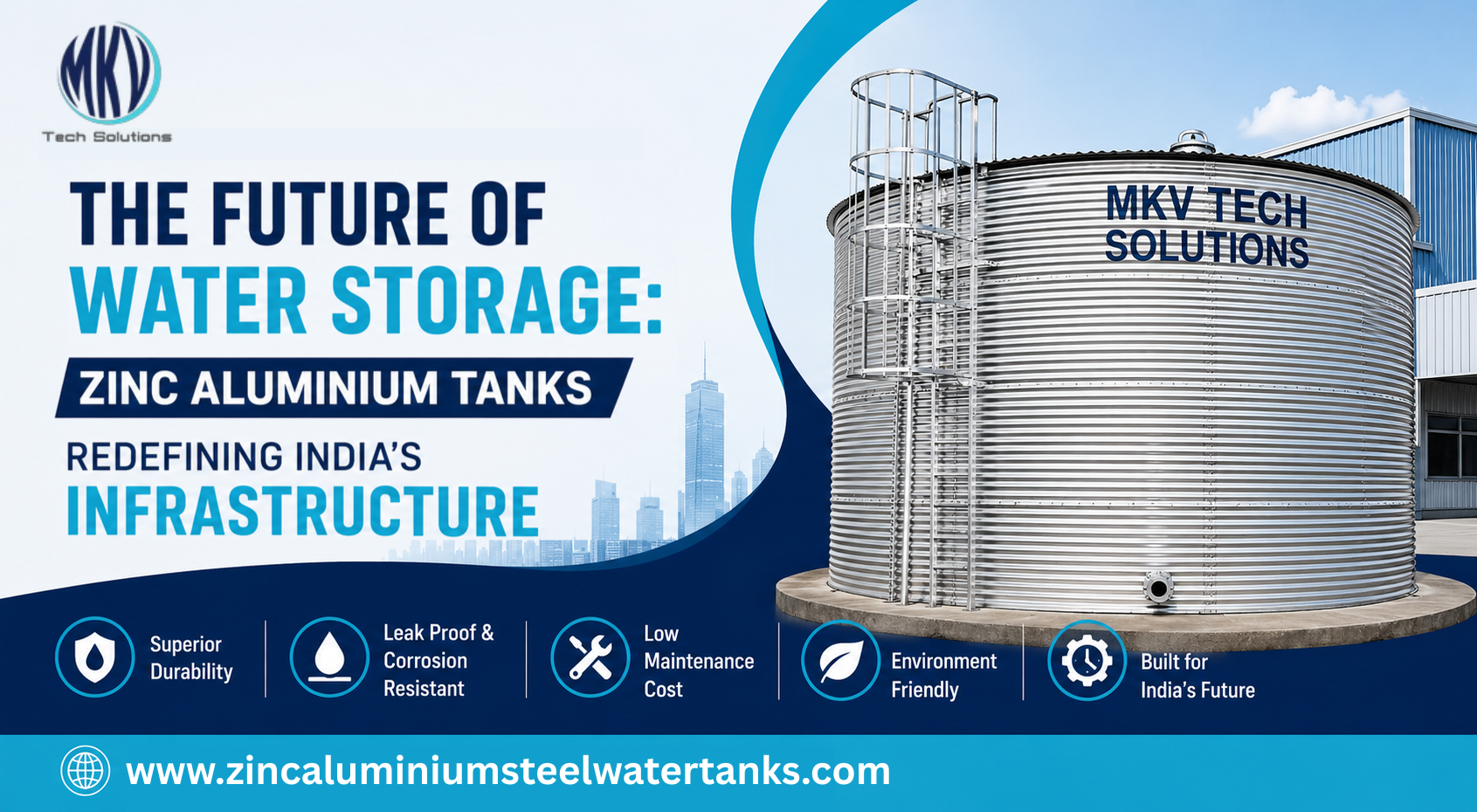
Are Zinc Aluminium Water Storage Tanks Really Worth It for Indian Homes and Industries?
Honestly? Yes — and once you understand why, you'll wonder why you didn't switch sooner.
I'll be straight with you. Most of us never really think about our water tank — until something goes wrong. Until you notice a faint rust smell in your water. Until the tank cracks after one brutal summer. Until your plumber tells you it needs replacement again.
That moment is frustrating. And it's more common in India than you'd think.
Over the last few years, something has been quietly changing in how builders, homeowners, and industries across India approach water storage. Zinc Aluminium Water Storage Tank have gone from being a "premium alternative" to becoming the practical, sensible choice — not just for big commercial projects, but for regular households too.
This blog breaks down everything in simple language — no jargon, no sales talk. Just what you need to know.
Here's a question worth asking — how old is your current water tank?If it's a plastic overhead tank, chances are it's been sitting up there for years, absorbing UV rays, expanding in summer heat, and slowly becoming a home for algae and bacteria you can't see.If it's a galvanised iron tank, rust is probably already happening somewhere inside it — whether you know it or not.Neither of these is dramatic.It's just the reality of using materials that weren't designed for India's extreme temperatures, hard water conditions, and long-term use without much maintenance.The problem isn't the people using them. The problem is the product itself.
Without getting too deep into chemistry — Zinc Aluminium alloy is basically the best of both worlds. Zinc protects against rust and corrosion. Aluminium adds strength while keeping the weight manageable.Together, they create a surface that genuinely holds up over decades.Here's a side-by-side look at how these tanks compare with what most people currently use:
|
Feature |
Plastic Tank |
Galvanised Iron Tank |
Zinc Aluminium Tank |
|
How Long It Lasts |
5–8 years |
7–10 years |
20–25 years |
|
Rust & Corrosion |
Doesn't rust, but degrades |
Rusts over time |
Highly resistant |
|
Handles Indian Heat? |
Warps and cracks |
Holds but sweats |
Handles it well |
|
Safe for Drinking Water |
Depends on grade |
Rarely certified |
Yes, BIS certified |
|
Maintenance Needed |
Moderate cleaning |
Frequent checks |
Very little |
|
Long-Term Cost |
High (keeps replacing) |
High (repairs + rust) |
Low |
|
Eco Impact |
Plastic waste |
Rust disposal |
Recyclable |
When you lay it out like this, the choice feels obvious. The Zinc Aluminium tank costs a bit more today — but it saves you money, stress, and health concerns over the next two decades.
There's no single "best" tank for everyone.Here's how to figure out what actually works for your situation:
A simple starting point: 135 litres per person per day is the standard guideline in India. Multiply that by your household or facility size, then add about 20% extra as a buffer.That gives you your minimum tank capacity.
Pick a size that actually matches your daily usage — not just what looks good on paper. Whether it's a 500-litre tank for a flat or something much larger for a housing society, manufacturers here have options for every scale. Just be honest about what you need.
Seriously, don't skip this one. BIS certification means someone outside the factory has actually checked the material and signed off on it. If a manufacturer fumbles when you ask for it — or says "it's in process" — that tells you everything.
The industry-standard coating is roughly 55% aluminium, 43% zinc, and a small percentage of silicon. Any reputed manufacturer will share this openly. If they're evasive about it, that's a red flag.
Both options exist. Overhead tanks work well for gravity-based water pressure.Underground tanks are better for larger storage with pump systems.Your plumber or contractor can guide you based on your property setup.
Good Zinc Aluminium Water Storage Tank Manufacturers stand behind their product with 10 to 15-year structural warranties. If the warranty is vague or short, the manufacturer probably isn't confident in what they're selling. Simple as that.
Q1. What is a Zinc Aluminium Water Storage Tank?
It's a steel tank coated with a Zinc-Aluminium alloy — that coating is what stops rust, handles the heat, and keeps your water clean for decades. Much better than what most of us grew up using.
Q2. Is it safe for drinking water?
Yes. Any tank from a certified Zinc Aluminium Water Storage Tank Manufacturer carries BIS approval — meaning it's been properly tested for potable water storage. No rust, no leaching, no worries.
Q3. How long does it actually last?
Around 20 to 25 years in real Indian conditions. Compare that to a plastic tank that starts giving trouble by year 6 or 7 — and the slightly higher price starts making a lot of sense.
Q4. Are there good manufacturers in India?
Vadodara and Ahmedabad in Gujarat, parts of Maharashtra, Tamil Nadu — honestly, India has no shortage of solid Zinc Aluminium Water Storage Tank Manufacturers. You don't need to look abroad. The real work is just finding one that's certified and transparent about what they're selling.
Q5. Works for a regular home too?
100%. Sizes start from 500 litres. These aren't just for factories or big projects — your family's daily water deserves the same quality too.
Q6. How do I pick a trustworthy manufacturer?
Ask for their BIS certificate, check warranty terms carefully, and if you're placing a big order — just visit the facility. A confident manufacturer won't hesitate.
Contact Us
Get in Touch